|
รายละเอียดสินค้า:
|
| รายการ:: | แผ่นซับเตียงรถบรรทุกขยะพลาสติก UHMWPE | วัสดุ: | UHMW โพลีเอทิลีน |
|---|---|---|---|
| สี:: | ขาวธรรมชาติ, ดำ, เหลือง | ขนาด:: | 1220*2440 |
| ความหนา:: | 5-200มม | ความหนาแน่น:: | 0.94-0.98 ก./ซม.3 |
| บริการการประมวลผล:: | ตัด, ปั้น | คุณสมบัติ: | ซับบังเกอร์พลาสติกแบบหล่อลื่นในตัว |
| เน้น: | UHMWPE เตียงรถบรรทุกขยะพลาสติก,โพลีเอทิลีน UHMWPE Liner,รางรถบรรทุก UHMWPE Liner |
||
Listing 37619779
แผ่นรอง UHMW polyethylene สำหรับกระบะดั้มและรางลำเลียงสินค้าที่เป็นผงและเม็ด สินค้านี้อยู่ในหมวดหมู่ UHMWPE Liner ภายใต้ชื่อรุ่น UHMWPE Plastic Dump Truck Bed และจัดจำหน่ายโดย Tangyin Taixing Engineering Plastics Co., Ltd.
| Field | Value held against this listing |
|---|---|
| Item designation | แผ่นรองกระบะดั้ม UHMWPE Plastic Dump Truck Bed Liner Sheet |
| Model Number | UHMWPE Plastic Dump Truck Bed |
| Manufacturer | Tangyin Taixing Engineering Plastics Co., Ltd. |
| Material | UHMW polyethylene |
| Panel size | 1220 x 2440 mm |
| Thickness range | 5-200 mm |
| Density range | 0.94-0.98 g/cm3 |
| Colour options | Natural white, black, yellow |
| Recorded feature | Self lubricating, non-sticking bunker lining |
| Processing | Cutting, moulding |
| Certification | ISO9001 quality management system |
| Origin | China |
| Order floor | 10 pieces |
| Price | Negotiable |
| Payment | T/T, Western Union |
| Monthly supply | 50,000 pieces per month |
| Delivery | 15-20 days after deposit received |
| Packaging | Wooden crate or pallet |
Two source conflicts were resolved before this page was written. The description carries a size line reading 1200 x 2400 mm, 1200 x 4000 mm and 12100 x 3100 mm, which is corrupted and inconsistent with the attribute record; the attribute size 1220 x 2440 mm governs. The description also answers a general colour question with a palette of red, yellow, blue, black, green, grey and dual colour, which belongs to the company's wider sheet range; the three colours recorded against this listing are natural white, black and yellow.
| Attribute | This listing | Factory statement |
|---|---|---|
| Sheet size | 1220 x 2440 mm | One of the three stated standard formats: 1250 x 3100 mm, 1220 x 2440 mm, 2100 x 3100 mm; custom sizes accepted. |
| Thickness | 5-200 mm | Factory states 6 mm to 200 mm for standard sheet, so the 5 mm end of this band is a listing-specific offer to confirm at enquiry. |
| Cutting | Cutting service offered | CNC precise finishing machine, carving machine and CNC machining centres on site. |
| Colour | Natural white, black, yellow | Dual colour HDPE sheet is a separate product in the stated range, not an option on this line. |
| Property | Figure published in the description | How to read it |
|---|---|---|
| Sliding friction coefficient | 0.05 to 0.11 | Quoted twice in the source text, once as a band and once as 0.11; both describe the same unlubricated sliding face. |
| Water absorption | Below 0.01 percent | Stated as a maximum; a wet load does not swell the panel. |
| Impact strength | 140 kJ/m2 or above | Lower bound, not a measured value for a specific panel. |
| Tensile strength | 22 MPa at 23 deg C in air | Test condition is part of the published figure. |
| Breaking strength | 42 MPa | Separate figure in the same table. |
| Temperature resistance | -269 deg C to +90 deg C | Bracket as published; verify your load temperature against it. |
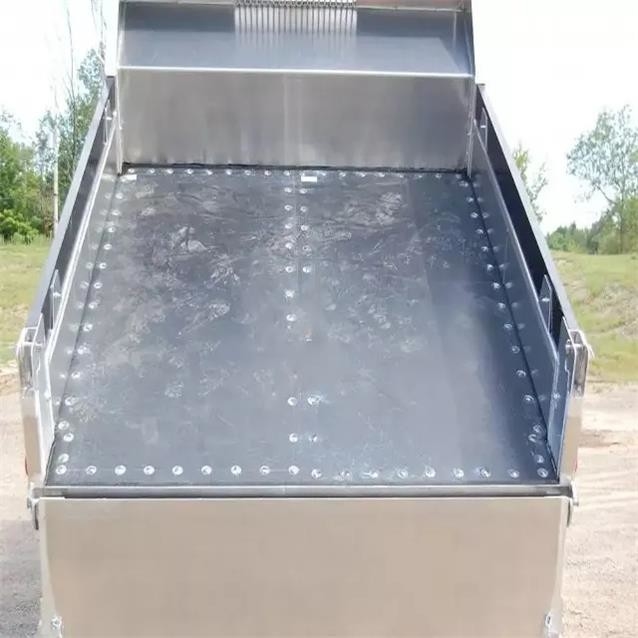
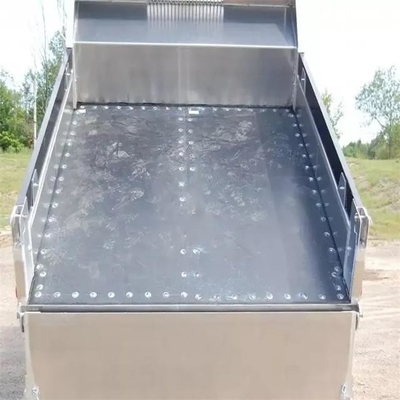
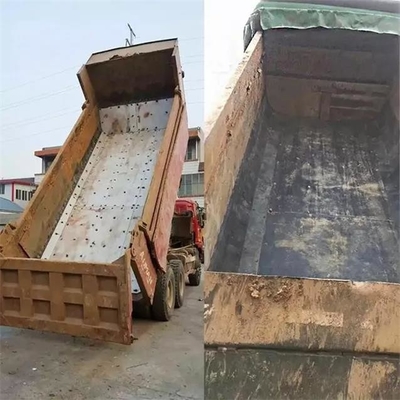
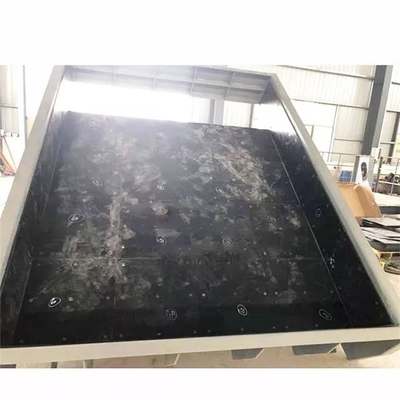
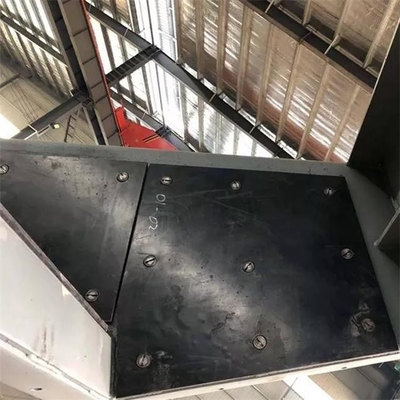
The description states that plates are pressed on a numerically controlled hot press from pure new raw material, which is consistent with the smooth face finish visible in the supplied photographs. No batch test certificate is recorded for this listing, so these figures guide selection rather than acceptance.
Construction
This liner is built for a discharge event rather than for continuous flow. On a tipping body the load sits still while the vehicle travels, then the body lifts and the whole mass has to break contact with the floor and slide out through the tailgate in one pass. The recorded friction band of 0.05 to 0.11 is the property that makes that pass possible at a lower tip angle, and the recorded 5-200 mm thickness band sets how many discharge cycles the floor can take before the face is worn through.
The construction is a single-material panel: UHMW polyethylene through the full section, with no bonded facing and no lubricant that can be washed off. Wear removes polyethylene, it does not expose a different surface, so the sliding behaviour at the end of the panel's life is the same as at the start, only the section is thinner.
On a 1220 x 2440 mm format the floor of a typical body is covered in a small number of panels laid with their long side along the direction of discharge. Panels run from the headboard to the tailgate so that the load crosses panel joints in line with travel rather than at right angles to it. Each joint is a potential catch point for a damp load, and aligning joints with the flow keeps the catch to a single seam rather than a repeated step.
The floor is not flat underneath: crossmembers and longitudinal beams create high and low lines. The liner must be packed or bedded so that it bears on those high lines without bridging over the lows, because a panel that spans a hollow between two crossmembers will flex every time the body is tipped and will eventually crack along the span.
The most heavily worked part of the panel is the rear edge, where material leaves the body. That edge is a cut polyethylene edge, and it is the first place where a panel can lift if the fixing spacing is too wide. Fixings should run close to the tailgate end so the last section of panel cannot peel back under the drag of a discharging load.
The gap between the liner edge and the tailgate should be small but not closed. Closing it completely traps material and prevents the panel from moving as it warms, while leaving it wide allows fines to pack behind the panel and push it away from the floor over time.
Side walls see less abrasion than the floor but more impact from a grab bucket or an excavator bucket loading the body. A panel on the wall can be thinner than the floor panel and still perform, which is one reason the 5-200 mm band is offered as a range rather than a single figure. At the corner where floor meets wall, a moulded or machined transition piece keeps the discharge path continuous; a square internal corner holds a wedge of material that the next load compacts against.

The hot-pressed face is smooth and non-porous, so wet coal or damp sand does not key into it. That is what allows a body to empty cleanly in cold weather, when a steel floor would hold a frozen layer. It also means the panel should not be scored during installation; a deep scratch across the discharge direction creates a line where fines can start to build.
This panel is for surfaces that a bulk solid slides over: truck beds, chutes, hoppers, bunkers, conveyor troughs and skirting, ship holds, rail cars and loader buckets. The description lists all of these, and the common requirement is a sliding face that resists abrasion and does not bond to the load.
The liner is not a wear plate for hot material. The recorded bracket tops out at +90 deg C, so a load that arrives hot from a dryer, a kiln or a fresh asphalt batch is outside what this listing records. It is also not a structural repair: a corroded truck floor must be made sound before a liner is fitted over it, because the panel transfers its fixing loads into whatever steel is beneath.
It is not a high-friction surface. The recorded friction band is low by design, so any application that needs grip, such as a walkway or a load platform where a pallet must not slide, is the opposite of this product's purpose.
Work from the headboard toward the tailgate. Fix each panel fully before starting the next, and keep the panel pressed against the floor while the holes are drilled so that swarf does not sit between panel and steel. Drill through the panel and the floor together where the two can be clamped, so the holes line up and no reaming is needed afterwards.
Fasteners must finish flush or below the face. On a tipping body anything standing proud is struck by the load on every discharge and will either wear away or pull through. A countersunk head with a bearing washer is the normal detail; the washer spreads the clamp load across the softer polyethylene.
Polyethylene grows more than steel over the same temperature change, and a truck body sees a wide daily swing between a cold night and a sunlit steel floor. Joints should be set with a running gap and panels should not be drilled tight against their holes; a slightly oversized hole lets the panel move without shearing the fixing.
At the tailgate edge, leave the panel free to move rearward rather than clamped hard at both ends. A panel restrained at both extremities has nowhere to relieve expansion and will bow upward into the discharge path.
Confirm the floor is straight along the crossmembers and that no rivet head or weld bead will sit under the panel. Confirm the delivered thickness matches the duty: floor panels carrying rock need more section than wall panels carrying grain. Confirm the cut pieces match the body dimensions, including the tailgate gap, before any hole is drilled.
Confirm the colour against the order where colour identifies a fleet or a material stream, and confirm piece count against the body area with an allowance for cutting at corners and around the discharge lip.
Tangyin Taixing Engineering Plastics Co., Ltd. makes this liner. The company combines production, sales, design and processing of engineering plastics, with more than 20 years of experience, a plant above 25,000 square meters and annual output above 8,000 tons. The stated range includes UHMWPE liner and UHMWPE board alongside HDPE sheet, dual colour HDPE sheet, HDPE ground protection mat, outrigger pad, synthetic ice rink, PE marine fender, plastic conveyor roller and UHMWPE special-shaped parts. The export side of the same business is recorded separately as Beijing Silk Road Enterprise Management Services Co.; both names refer to one manufacturing and export organisation.
Sheet is pressed on the moulding press and the imported production line, which is what makes a 5-200 mm thickness band available from a single source. Cutting and moulding are the two services recorded for this listing and are performed on the CNC precise finishing machine, the carving machine and the CNC machining centres, with AutoCAD based design support for a body that needs a shaped floor piece rather than a rectangle.
The in-house laboratory holds an abrasion tester, a universal mechanical tester and an oxygen index tester. Those instruments support material control and the property figures published in the description; they are not a per-panel certification service.
ISO9001 is recorded here as a quality management system certification covering the manufacture of polyethylene sheet and machined plastic products. It is a system certification and not a product-by-product approval, and it is not a material test report. No certificate number, issuing body or product scope is recorded, and none is claimed.
| Term | Recorded | Effect on a fleet reline |
|---|---|---|
| Minimum order | 10 pieces | Enough for one body with spares, or for a split between floor and wall panels on a small fleet. |
| Monthly supply | 50,000 pieces | Supports a rolling reline programme rather than a single one-off purchase. |
| Delivery | 15-20 days after deposit | Sequence vehicle downtime around the payment date, not the enquiry date. |
| Packaging | Wooden crate or pallet | Cut pieces travel flat and protected; confirm crate mass for yard handling. |
| Payment | T/T, Western Union | Two recorded routes; agree one before the deposit is raised. |
| Price | Negotiable | Quotation follows thickness, colour and cutting, so specify all three in the enquiry. |
Because a tipping body usually needs more floor panels than wall panels at a different thickness each, the order is normally mixed. State both thicknesses and both quantities in the same enquiry so that the 10 piece minimum is assessed against the whole order rather than against one line.
The published figure for this material is a sliding friction coefficient of 0.05 to 0.11, and that is the number that decides how far a body must be tipped before the load releases. With the Tangyin Taixing Engineering Plastics Co., Ltd. UHMWPE Plastic Dump Truck Bed fitted, the load breaks contact with the floor earlier in the lift, which shortens the discharge and reduces the amount of material left in the corners.
That band is a material property, not a guarantee for a specific load. Damp clay and frozen coal behave differently from dry grain, so the figure tells you the direction of the benefit rather than a specific tip angle for your site.
Lay the long side of each Tangyin Taixing Engineering Plastics Co., Ltd. UHMWPE Plastic Dump Truck Bed panel along the direction of discharge and run panels from headboard to tailgate, so the load crosses seams in line with its own travel. On a floor narrower than 2440 mm the panel is cut lengthwise and the offcut becomes the second run.
Pack any hollow between crossmembers before fixing. A panel that spans a gap will pump up and down each time the body lifts, and that flexing, not abrasion, is what cracks a liner along a crossmember line.
Put fixings close to the rear edge of the Tangyin Taixing Engineering Plastics Co., Ltd. UHMWPE Plastic Dump Truck Bed panel. The last stretch of panel before the tailgate sees the highest drag of the whole floor, and an unsupported edge peels back first, lifting into the path of the load.
Keep the gap to the tailgate small but open, so the panel can move when it warms without trapping material behind it. Where the body has a steel lip at the rear, check that the panel edge finishes flush and does not stand proud of the lip where a bucket or a loader tyre could catch it.
No. Tip angle is set by the friction between the load and the liner face, and the face is the same UHMW polyethylene at any thickness in the 5-200 mm band. What thickness changes is how long that face survives: a floor carrying rock at a high drop height needs more section than a wall carrying grain.
A thicker Tangyin Taixing Engineering Plastics Co., Ltd. UHMWPE Plastic Dump Truck Bed panel also adds mass, at the recorded 0.94-0.98 g/cm3 density, which matters when one crew has to lift a 1220 x 2440 mm piece into a body. Choose thickness for wear life and handling, and expect the discharge behaviour to stay constant.
The attribute record sets three colours for this listing: natural white, black and yellow. The description's colour question lists red, blue, green, grey and dual colour, but that answer describes the company's general sheet range and is not the recorded configuration of the Tangyin Taixing Engineering Plastics Co., Ltd. UHMWPE Plastic Dump Truck Bed.
For a fleet, yellow is the practical choice because it shows up against dark loads when the body is inspected from ground level. Put the colour on the purchase order as a separate line, since the model string alone does not fix it.
Ten panels at 1220 x 2440 mm give roughly 29.8 square meters of nominal area before cutting. Whether that relines one body or several depends on whether the walls are lined as well as the floor, which is why the Tangyin Taixing Engineering Plastics Co., Ltd. UHMWPE Plastic Dump Truck Bed order should be split into floor and wall quantities before the minimum is assessed.
Cutting waste is real on a body with a shaped discharge end, so plan the order on the panel count you need after cutting, not on the raw area of the floor.
Cut polyethylene edges and the smooth sliding face are both easily damaged in transit. A crate or pallet keeps the Tangyin Taixing Engineering Plastics Co., Ltd. UHMWPE Plastic Dump Truck Bed panels flat and stops one panel sliding across the face of another, which would leave deep score lines exactly where the load has to slide.
It also keeps the stack rigid enough to be lifted as one unit. Confirm the crate dimensions against your yard access and check the packing list against the piece count before the crate is broken down, because a short delivery is much harder to prove once the stack is separated.
Each shipment starts its 15-20 day clock at deposit, and the recorded monthly supply of 50,000 pieces is far above any single fleet order. That combination lets you run the reline in stages: send one body's worth of Tangyin Taixing Engineering Plastics Co., Ltd. UHMWPE Plastic Dump Truck Bed panels, keep the vehicle in service, then call the next batch.
Staging avoids stacking panels in a yard where they can be walked on or bowed, and it lets you check the first installation before committing the rest. Raise each deposit against a dated call-off so the delivery window is measured from a date you control.
ผู้ติดต่อ: Mr. Sales
โทร: +86 152 1104 0646


 Thai